
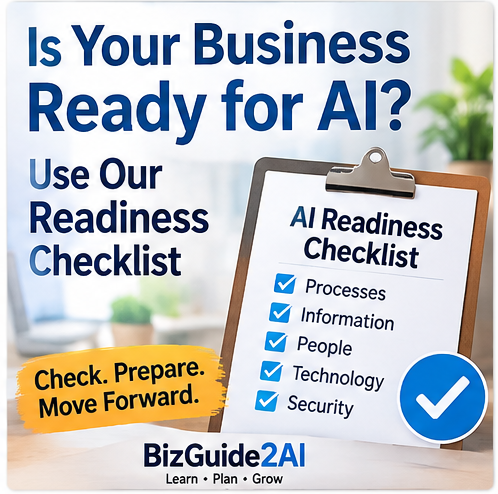
AI Readiness Checklist: Is Your Business Ready?
AI readiness checklist.
AI works best in businesses with a few basics in place. Use this checklist to see where you stand.
Artificial intelligence can help small businesses save time, improve communication and make better use of information. However, purchasing an AI subscription does not automatically make a business more efficient.
Before introducing AI, it is worth examining how the business operates, what information it has available and whether employees are prepared to use new tools.
This guide provides a practical checklist to help business owners assess their starting point.
1. Understand your business processes
AI is most useful when there is a clear task or problem to address.
Ask yourself:
- Do we understand how our routine work is completed?
- Are repetitive tasks identified?
- Do employees know which activities consume the most time?
- Are our existing procedures reasonably consistent?
- Do we know where delays and mistakes occur?
If the answer to most of these questions is no, start by documenting a few important business processes.
For example, a company might document how it receives an enquiry, prepares a quotation, confirms an order and follows up with a customer.
Once the process is understood, it becomes easier to identify where AI might help.
2. Review your business information
AI tools can work with written information, documents and other business data, depending on the service and plan being used.
However, businesses should understand what information they have and whether it is accurate and appropriately protected.
Consider:
- Are customer enquiries organized?
- Are product and service descriptions up to date?
- Are frequently asked questions documented?
- Are business procedures written down?
- Do employees know which information is confidential?
For example, ChatGPT could help turn a collection of approved service descriptions into a consistent set of customer-facing answers.
However, the business must supply accurate information and review the results.
3. Assess employee skills and willingness
Employees do not need to become programmers to use many AI tools.
They do need basic instruction.
Ask:
- Are employees comfortable using digital tools?
- Can they explain what information should not be shared?
- Do they know how to review AI-generated content?
- Is someone responsible for checking important outputs?
- Is there time available for training?
A short training session can introduce employees to useful prompts, common limitations and appropriate business applications.
4. Check your technology
Some AI applications work independently through a web browser. Others need to connect with existing business systems.
Review:
- Internet access and reliability.
- Computers and mobile devices.
- Existing accounting and customer management software.
- Email and document systems.
- Security and user-access arrangements.
Do not assume that every AI application will work with every existing business system. Check compatibility before committing to a purchase.
5. Your AI readiness checklist
Use the following checklist to assess your current position.
| Area | Ready when… |
| Business processes | Repetitive tasks are identified and understood |
| Information | Important business information is accurate and organized |
| Employees | Staff understand basic AI use and limitations |
| Technology | Suitable devices and internet access are available |
| Security | Rules exist for protecting confidential information |
| Management | Someone is responsible for evaluating AI results |
| Measurement | The business can measure time, cost or quality improvements |
Give yourself one point for every area where your business meets the description.
Your score:
- 6–7 points: You have a good foundation for a carefully selected AI pilot.
- 4–5 points: You may be ready to experiment, but some preparation would help.
- 0–3 points: Begin by improving your processes, information and basic technology arrangements.
This is an informal self-assessment, not a scientific measurement or guarantee of successful AI adoption.
6. How ChatGPT can help assess readiness
ChatGPT can help business owners organize their thoughts and identify possible starting points.
Try this prompt:
“Act as an AI readiness adviser for a small business. Our business is [describe the business]. We have [number] employees. Our main activities are [list activities]. Help us assess our readiness for AI in the areas of business processes, information, employee skills, technology and security. Identify five practical improvements we should consider before starting an AI project.”
You can then review the suggestions and decide which are appropriate.
Do not enter confidential business or customer information into a service unless its use is permitted under your organization’s policies and the provider’s terms.
7. Start with one manageable project
A business does not need to automate everything at once.
Consider testing ChatGPT for one of these tasks:
- Drafting customer emails.
- Preparing social media content.
- Summarizing internal documents.
- Creating staff checklists.
- Developing frequently asked questions.
Choose a task that is easy to review and does not involve high-risk decisions.
Record how much time it takes before and after introducing AI.
If the results are positive, consider the next opportunity.
Final thoughts
AI readiness is not about having the newest technology. It is about understanding your business, organizing important information, preparing employees and identifying worthwhile problems to solve.
A little preparation can prevent wasted subscriptions and disappointing results.
Want a more structured assessment? BizGuide2AI offers a Free Business AI Audit/Snapshot to help identify potential opportunities, readiness gaps and possible next steps for your business.