
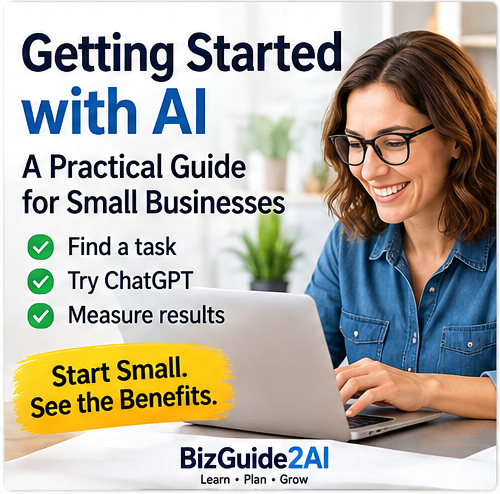
Getting Started with AI: A Practical Guide for Small Businesses
Getting Started with AI: A Practical Guide for Small Businesses
You don’t need a technical team to start using AI. You need a clear picture of where your time goes and one small, measurable test.
Many small-business owners are interested in artificial intelligence but are unsure where to begin. They may assume that AI requires expensive software, technical expertise or a complete change to the way their business operates.
In reality, many useful AI applications can be tested using ordinary business tasks and straightforward instructions.
The best approach is to start small, solve one problem and measure the results.
1. Identify where your business spends time
Before choosing an AI tool, look at the tasks that occupy your working day.
Common examples include:
- Responding to routine customer emails.
- Preparing quotations and proposals.
- Writing social media content.
- Producing newsletters.
- Summarizing meeting notes.
- Organizing information.
- Preparing product descriptions.
- Drafting employee instructions.
Some of these tasks are repetitive and do not require a great deal of original decision-making. They may be suitable candidates for AI assistance.
Make a list of the five tasks that consume the most time. Then identify one that is relatively low-risk and easy to measure.
2. Start with ChatGPT
ChatGPT is a practical starting point for businesses that want to experiment with AI without hiring a programmer.
It accepts instructions written in everyday language and can help produce drafts, summaries, ideas, checklists and other working documents.
For example, a small plumbing company might ask:
“Create a professional email responding to a customer who has requested a quotation for replacing a kitchen faucet. Explain that we need the customer’s address, faucet details and preferred appointment time before preparing an estimate.”
The business owner can review the draft, correct any details and send an appropriate response.
Another example would be a retail store asking ChatGPT to develop a week’s worth of social media ideas around a seasonal promotion.
The important point is that the business owner remains responsible for checking the final content.
3. Conduct your first AI experiment
Choose one task and establish how long it normally takes.
For example, suppose a business owner spends 45 minutes preparing a weekly newsletter.
The owner could use ChatGPT to prepare an initial draft based on:
- The business’s products or services.
- Current promotions.
- Important customer information.
- The desired tone.
- The newsletter’s intended audience.
The owner then reviews and edits the result.
Record the time required for the traditional process and the AI-assisted process.
| Measurement | Before AI | With AI |
| Drafting time | 45 minutes | 20 minutes |
| Editing time | 10 minutes | 15 minutes |
| Total time | 55 minutes | 35 minutes |
In this example, the business saves 20 minutes each week.
That may not sound dramatic, but small improvements across several tasks can add up.
4. Five practical AI applications
Here are five areas where a small business could begin experimenting.
Marketing: Use ChatGPT to draft social media posts, advertising ideas, newsletters and promotional messages.
Customer communication: Prepare responses to common questions and draft follow-up emails.
Administration: Summarize meeting notes, create checklists and organize written information.
Sales: Develop product descriptions, proposal outlines and customer follow-up messages.
Planning: Brainstorm new services, prepare project plans and organize business priorities.
AI should support employees rather than replace their judgment. Important decisions, commitments and customer communications still require human oversight.
5. Learn to write better AI instructions
The quality of an AI response often depends on the quality of the instructions.
A useful prompt should explain:
- What the business does.
- Who the intended audience is.
- What task needs to be completed.
- What tone or format is required.
- Any important limitations.
For example:
“Act as a marketing assistant for a family-owned bakery in Ontario. Write three Facebook posts promoting our weekend selection of fresh bread and pastries. Use friendly language, avoid exaggerated claims and include a suggestion to visit our store.”
This provides more useful direction than simply asking AI to “write a Facebook post.”
6. Protect your business information
Before using AI, establish basic rules for employees.
Do not enter passwords, confidential customer information, payment details or sensitive employee records into an AI service without appropriate authorization and safeguards.
Review the provider’s privacy and data-use policies. Consider business-oriented plans when stronger administration and data controls are required.
Always check important information generated by AI. It can make mistakes, misunderstand instructions or produce information that sounds convincing but is incorrect.
7. Measure whether AI is working
After two to four weeks, ask:
- Did the task take less time?
- Was the quality acceptable?
- Did employees find the tool useful?
- Were there any errors?
- Did customers benefit?
- Is the result worth the cost?
If the experiment succeeds, consider expanding it to another task.
If it does not, change the process or try a different application.
Final thoughts
Small businesses do not need to transform everything overnight to benefit from AI.
Start with one task, use a straightforward tool such as ChatGPT, measure the results and learn from the experience.
A successful first experiment provides a practical foundation for further AI adoption.
Take the next step: BizGuide2AI’s Free Business AI Audit/Snapshot can help your business identify possible AI applications and decide where to investigate first.